- Emergency Line: 08022225555 / 08022960390 / 9958816886
- Location: Bangalore, Pune, Hyderabad
- 24/7 - Available
- Emergency Line: 08022225555 / 08022960390 / 9958816886
- Location: Bangalore, Pune, Hyderabad
- 24/7 - Available
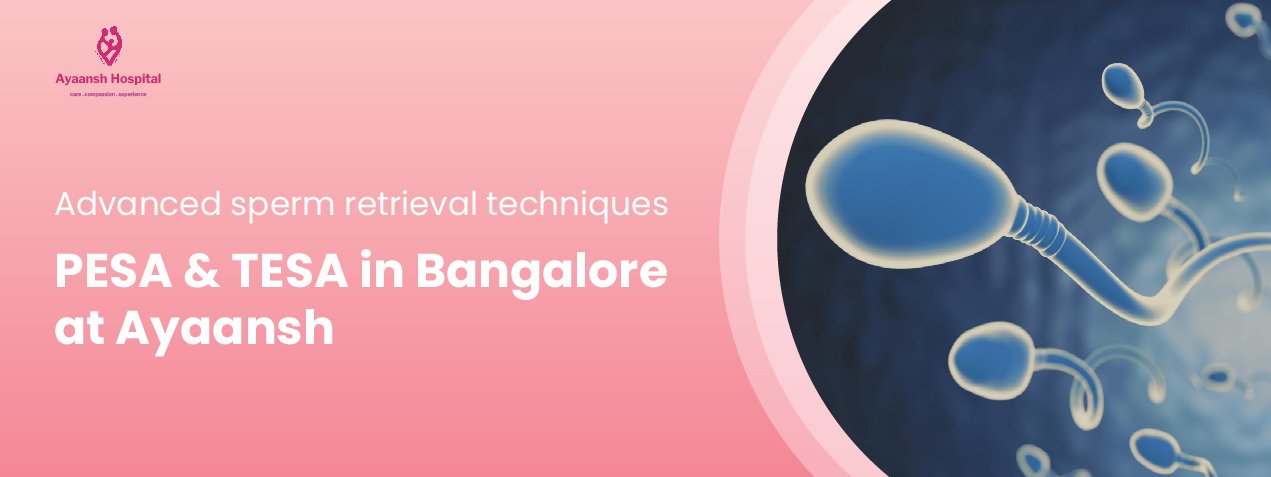
Male infertility is a common yet often misunderstood cause of delayed conception. In many cases, the absence of sperm in semen, known as azoospermia, does not mean sperm production is impossible. Advanced sperm retrieval techniques like PESA and TESA in Bangalore offer effective solutions for men facing such challenges. At Ayaansh Hospital, these procedures are performed as part of a structured male fertility evaluation, ensuring the right technique is chosen based on the underlying condition.
PESA and TESA are minimally invasive procedures designed to retrieve viable sperm directly from the reproductive tract when ejaculation does not yield sperm. These techniques play a crucial role in assisted reproductive treatments such as IVF and ICSI, enabling couples to move forward with fertility treatment using the male partner’s own sperm. The choice between PESA and TESA depends on factors such as the cause of azoospermia, hormonal profile, testicular function, and prior medical history.
Percutaneous Epididymal Sperm Aspiration, also known as PESA, is a minimally invasive procedure done under local anaesthesia used to collect sperm when it is not found in a man’s semen. In many cases, sperm is being produced normally but cannot come out due to a blockage. During PESA, a doctor uses a fine needle to gently collect sperm from the epididymis, where sperm is stored. The sperm retrieved through PESA is commonly used for fertility treatments such as IVF with ICSI, helping couples move forward with their treatment plan.
TESA is a sperm retrieval technique used in cases of male infertility when sperm is absent in ejaculation. Instead of passing out naturally, sperm is collected directly from the testicles using a thin needle. The procedure is quick, safe and causes minimal discomfort. TESA is often recommended when other methods are not suitable or when sperm needs to be retrieved directly from the source. Once collected, the sperm can be used for fertility treatments like IVF, ICSI, helping couples move forward with their fertility journey.
| Aspect | PESA | TESA |
| Where sperm is retrieved from | Epididymis (the tube that stores sperm) | Testicles (where sperm is produced) |
| When it is recommended | When sperm production is normal but blocked from coming out | When sperm needs to be retrieved directly from the testicles |
| Common condition treated | Obstructive azoospermia | Obstructive and non-obstructive azoospermia |
| Procedure type | Minimally invasive | Minimally invasive |
| Technique used | Fine needle aspiration | Fine needle aspiration |
| Anaesthesia | Local anaesthesia | Local anaesthesia |
| Recovery time | Usually quick, same-day recovery | Usually quick, same-day recovery |
| Use in fertility treatment | Used with IVF-ICSI | Used with IVF-ICSI |

Role of PESA in Male Infertility
Role of TESA in Male Infertility
Process of PESA (Percutaneous Epididymal Sperm Aspiration)
The fertility specialist reviews semen analysis, hormone tests, and scans to confirm obstructive azoospermia.
PESA is usually performed as a day-care procedure under local anaesthesia.
A fine needle is gently inserted into the epididymis (where sperm is stored) to aspirate sperm.
The collected sample is immediately examined in the lab to check sperm quality and viability.
Suitable sperm is used or preserved for assisted reproductive procedures such as IVF with ICSI.
Process of TESA (Testicular Sperm Aspiration)
TESA is recommended after evaluating semen reports, hormones, and testicular health.
The procedure is performed under local anaesthesia, usually as a short day-care treatment.
A fine needle is inserted directly into the testicular tissue to retrieve sperm.
The aspirated tissue is examined in the lab to identify viable sperm.
Retrieved sperm is used immediately or frozen for IVF-ICSI treatment.
These procedures are recommended when semen analysis shows no sperm, usually due to blockage or issues with sperm release, even though sperm production may still be present.
Both procedures are minimally invasive and usually performed under local anaesthesia. Most patients experience only mild discomfort.
The procedures typically take 20–30 minutes and are usually done as day-care treatments.
Most patients can return to normal daily activities within a day or two, as recovery is usually quick.
Ayaansh Hospital offers experienced fertility specialists, advanced diagnostic support, ethical treatment planning, and seamless integration with IVF-ICSI care for optimal outcomes.
Yes PESA and TESA sperm retrieval techniques are performed by fertility specialists who are experts in male infertility and surgical sperm retrieval techniques.
Yes, Ayaansh Hospital manages both simple and complex male infertility cases, including obstructive and non-obstructive azoospermia.